
Print On Demand Quality: What To Really Expect
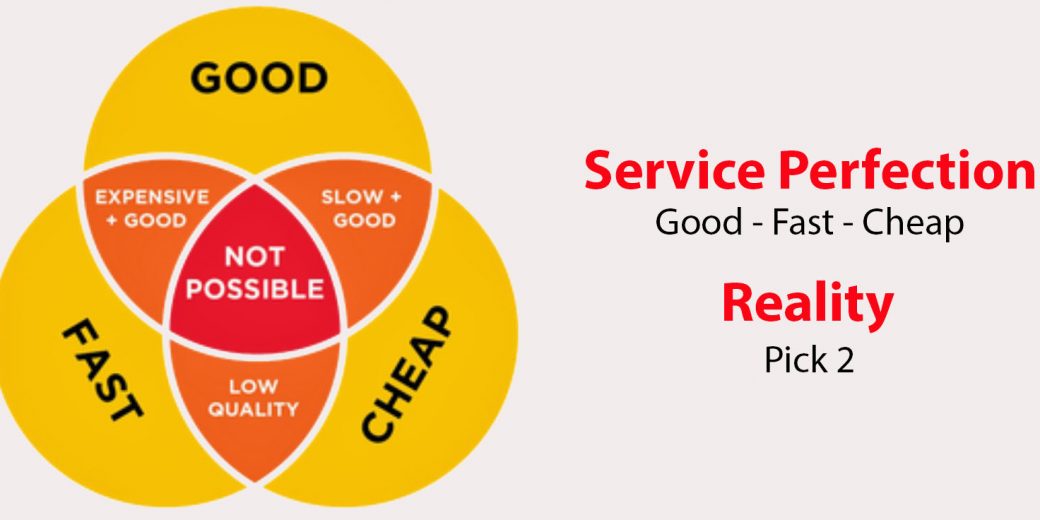
Print-on-demand runs on a promise that sounds too good to be true: high quality, quick turnaround, and a price that leaves you a margin, all at the same time.
The majority of the time, that’s exactly what you get from us.
But “the majority” is doing honest work in that sentence, and we would rather explain it than pretend it away. Print-on-demand is one-off manufacturing.
Every garment is produced on its own, after your customer has paid, and one-off production behaves differently from a warehouse full of identical stock.
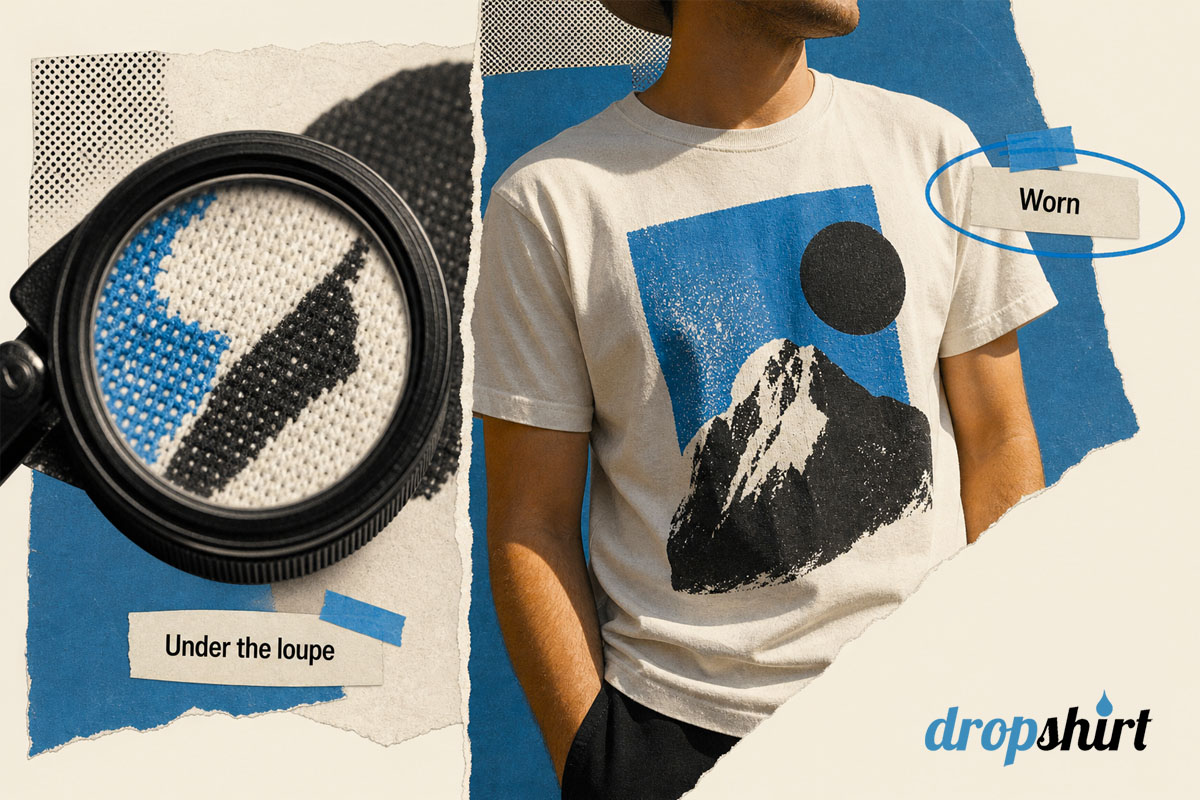
So here is the straight version. Where the quality lands, where it occasionally bends, and the standard we hold no matter what.
“Good, Fast, Cheap: Pick Two” Is A Real Rule
A well-known principle in project management is called the triple constraint, or the Iron Triangle.
It says every project is bounded by three things: quality, speed, and cost. Push hard on any one, and at least one of the others has to give.
The shorthand is blunt. Good, fast, cheap. Pick two.
A tailor making a single garment by hand gives you good and fast, but charges you accordingly.
A bulk screen-printer running ten thousand identical shirts gives you cheap and consistent, but you wait weeks, and you commit up front.
The trade is real, and anyone who tells you it doesn’t exist is trying to sell you something.
Where Print On Demand Bends The Triangle
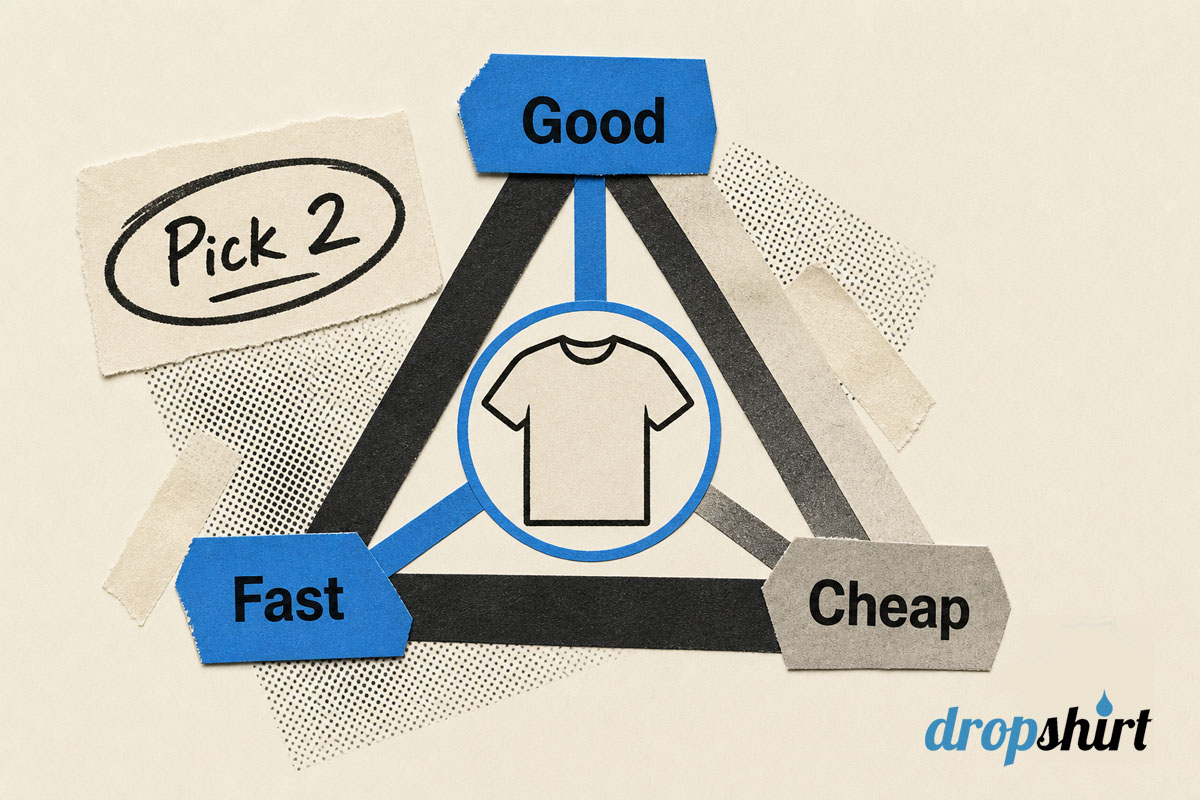
Print-on-demand earns its place because it gets you unusually close to all three at once. Good garments, printed fast, at a price that works without a bulk order. That’s why the model has taken off.
It’s not a small trend either. The global print-on-demand market was worth around USD 11.4 billion in 2025 and is growing roughly 20% a year, because sellers would rather print to demand than gamble on a bulk print run.
The catch is the one the triangle predicts. When you compress quality, speed and cost into a single on-demand garment, the element that occasionally slips is absolute, every-detail perfection.
Not quality in any way that matters to a customer wearing the shirt. The last two percent of showroom perfection that bulk production buys with time and volume.
Print-on-demand gets you good, fast and affordable on the same shirt. What it does not promise is that every unit is flawless under a magnifying glass. Those are different claims.
The Variances That Are Normal, And Why They Happen
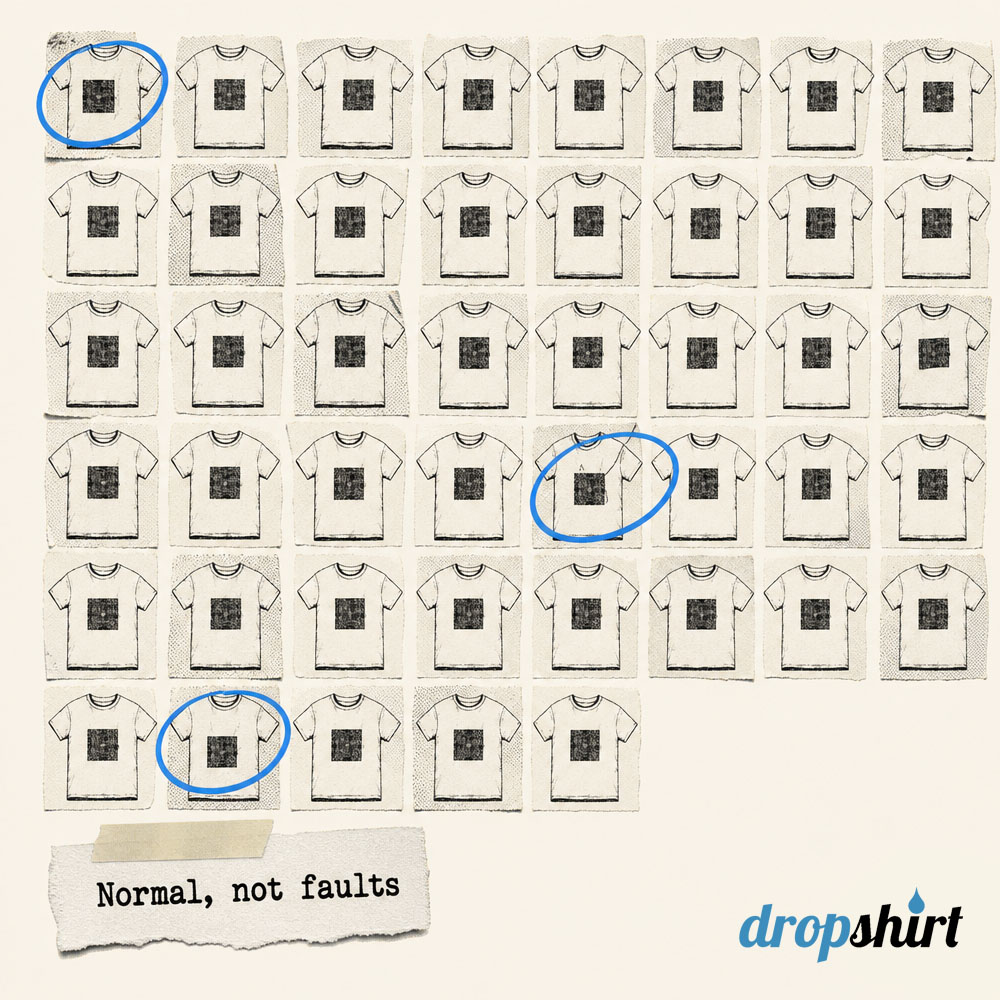
The misalignments are exaggerated for demonstration purposes just to show it can happen.
Here is the part most suppliers will not put in writing. Small variances are inherent to one-off garment decoration, not signs that something went wrong.
Knowing the difference is what keeps you satisfied instead of surprised.
Most of them trace back to how direct-to-garment printing actually works. Ink is applied to pre-treated fabric, and colour and finish shift with the fabric weave, the pre-treatment, and the colour profile.
Even the best-calibrated setup cannot guarantee 100% identical colour on every single unit, because cotton is a natural fibre and no two garments take ink in precisely the same way.
In practice, that shows up as things like these:
- A print colour that’s slightly warmer or cooler than on screen, because fabrics absorb ink differently
- A design that’s a hair off centre front-to-back, well, because where humans
- A rebranded neck label that’s not perfectly square, because it’s applied to a label that’s already stitched to the seam.
- A tiny thread remnant that wasn’t trimmed during garment manufacture
- Minor construction quirks in the blank itself, which is manufactured to garment-trade specification before it ever reaches us
An experienced operator in the garment trade would not blink at any of these. A first-time fashion brand expecting the finish of a high-end, premium, made-to-measure brand might.
The finish is genuinely good. It’s just held to the manufacturing industry specifications, not an impossible one.
What We Will Not Compromise On
Managing expectations is not code for lowering the bar. There’s a floor here, and it does not move.
We print on quality AS Colour and Gildan blanks, and we print them here in Australia, because the blank and the printing are the two things customers actually care about.
That’s a deliberate choice, and it’s the reason we are a value-first supplier rather than the cheapest name on a search page.
We’re still not expensive by any means. We offer a genuinely quality product. But if a two-dollar price gap is the difference between making money and losing money, you shouldn’t be in this business. Your prices are too low.
You need to sell a product that’s worth wearing. We built that for a seller who agrees.
Where Normal Ends And A Fault Begins
None of this means anything goes. There’s a clear line between an inherent variance and an actual defect, and the two are handled very differently.
If the print is faded, cracked, or peeling is a fault. A design printed in the wrong size or position is a fault. A misprinted or damaged garment is a fault.
That’s not how we do things; those are mistakes. And mistakes we immediately put right.
The normal variances are the small, cosmetic ones listed above, the kind that sit within garment-trade specification.
The faults are the ones that stop a shirt from doing its job. Keep that distinction in mind, and you will always know which is which, and so will we.
How To Set Your Expectations And Be Happy
The sellers who are happiest with print-on-demand are the ones who understand the situation before their first order.
Order a sample of your actual design on your actual blank before you launch. It’s the fastest way to see how your artwork sits on the fabric, so you’re confident with every following order.
Remember, direct-to-garment printing is not screen printing. It’s better for full-colour, photographic and short-run work, and it behaves like ink on fabric rather than a laminate sitting on top.
Proof your artwork at high resolution, because the print can only be as sharp as the file itself.
And judge the result the way your customer will. On the body, worn, at arm’s length. Not under a bright lamp with a magnifying glass, which is a test no garment on earth passes.
The Bottom Line
Print-on-demand gives you good, fast and affordable on the same shirt, which is a genuinely rare thing to get in one place.
The trade is that a one-off garment carries the small, normal variances of one-off manufacturing, and we would rather name them than hide them.
Set your expectations to the medium, and you will be satisfied the overwhelming majority of the time, on a product built to a standard we refuse to drop.
That honesty is the point. Sellers who know what to expect are the ones who come back.
Ready to see the quality on your own design? Create an account and order a sample.
If you’re still weighing whether the model fits your business, the honest benefits explainer is the place to start.
